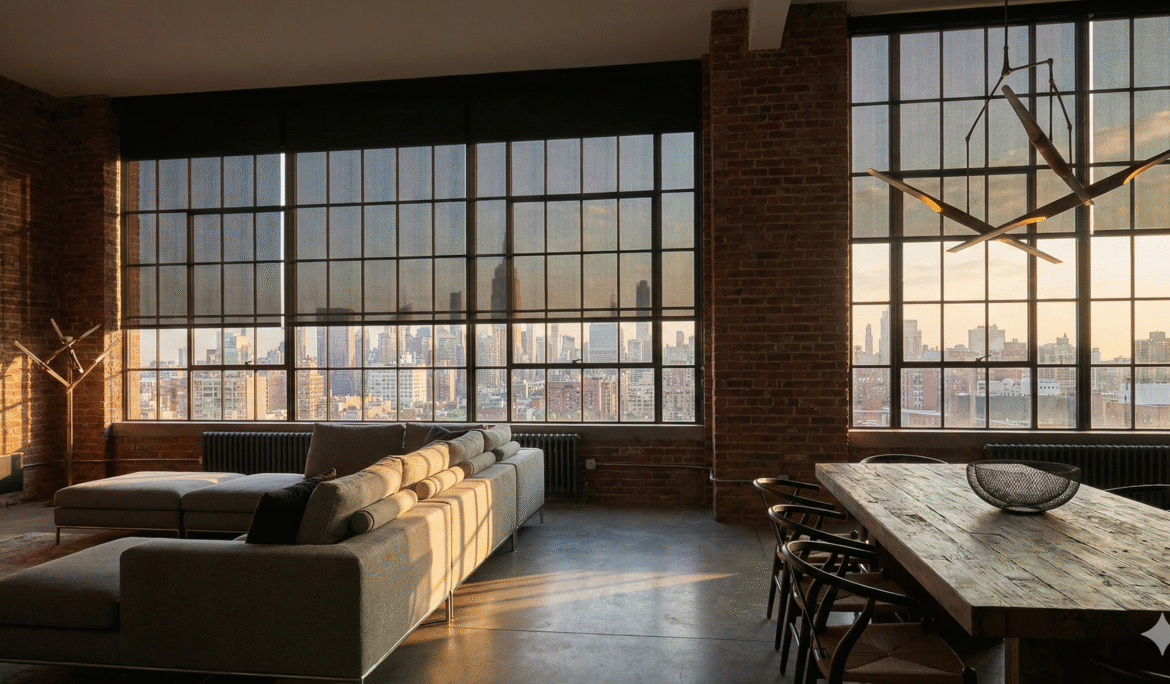
For NYC lofts with floor-to-ceiling windows, Motorized Solar Roller Shades are the industry standard. They manage heat and glare without blocking the skyline view, and the automation allows you to control hard-to-reach windows effortlessly. For sleeping areas within open-plan lofts, Dual Shades (Solar + Blackout) offer the necessary versatility.
The Loft Paradox: Massive Windows, Massive Heat
Living in a converted warehouse in Tribeca or a new build in Williamsburg comes with a specific architectural perk: massive, light-flooded windows. However, this creates the “greenhouse effect.” In the summer, your loft becomes an oven; in the winter, it leaks heat.
Standard blinds are often too heavy or visually cluttered for these heights (often 10–14 feet). The goal is to treat the window without hiding the architecture.
1. The Necessity of Automation (Motorized Shades)
In a standard apartment, manual cords are fine. In a loft with 12-foot windows, they are a liability.
- The Problem: Cords for tall windows are unsightly and dangerous. Plus, manually raising five heavy shades every morning is a chore you will eventually ignore, leaving your view permanently blocked.
- The Solution: Motorized Roller Shades. With distinct “channels,” you can raise all south-facing shades with a single voice command or tap on your phone.
- Tech Spec: We integrate with Lutron and Somfy systems, allowing your shades to adjust automatically based on the sun’s position, protecting your art and furniture from UV damage while you are at work.
2. Preserving the “Industrial Chic” Aesthetic
Lofts are prized for their raw elements—exposed brick, ductwork, and steel beams. Traditional drapery can feel too soft or “suburban” for this vibe.
- The Design Fix: Choose Exposed Roller Bars. Instead of hiding the shade mechanism in a cassette, we use sleek, architectural brackets (in matte black or brushed nickel) that leave the roller visible. This mechanical look complements the industrial bones of a loft.

3. Solar Shades: The View Without the Glare
If you have a view of the Manhattan skyline, the last thing you want is a solid fabric blocking it.
- Why Solar? Solar shades are woven to be semi-transparent. A 3% or 5% Openness Factor cuts 95% of the UV rays and glare—stopping your laptop screen from washing out—while still allowing you to see the Empire State Building clearly.
- Color Choice: Darker fabrics (Black or Charcoal) actually provide better views than light fabrics because they absorb reflection. They act like sunglasses for your windows.
4. The “Studio Loft” Problem: Sleeping in the Living Room
Many NYC lofts are open-plan studios. Solar shades are great for the day, but they offer zero privacy at night (people outside can see in when your lights are on).
- The Solution: Dual Shade Systems. This single bracket holds two rollers:
- Back Layer: A Solar Shade for daytime views.
- Front Layer: A Blackout Shade for nighttime privacy and darkness. This gives you total control over the environment without requiring bulky curtains.
5. Handling “Landmarked” Windows
Many SoHo cast-iron buildings have strict Landmark Preservation Commission (LPC) rules about what can be seen from the street.
- The Constraint: Often, the street-facing side of the shade must be white or beige.
- The Fix: We use custom fabrics with a “white backing.” You get the charcoal industrial look inside your loft, while the exterior remains uniform white to satisfy the building management and city code.
Installation: The Height Factor
Installing shades at 14 feet is not a DIY task. It requires scaffolding or tall ladders and precise leveling. A shade installed slightly off-level at that height will “telescope” (roll up crookedly) and ruin the fabric within months. Professional Shades uses laser-leveling technology to ensure perfect operation for oversized windows.
Frequently Asked Questions
Do I need to hire an electrician for motorized shades?
Not necessarily. While hardwired systems (low-voltage) are best for new renovations, we also offer battery-powered motorized shades. Modern rechargeable motors can last 6–12 months on a single charge and require no external wiring, making them perfect for retrofitting existing lofts.
How do I clean shades that are 14 feet high?
For high-up solar or roller shades, regular dusting with an extendable microfiber duster is usually sufficient. For deeper cleaning, the fabrics are durable enough to be lightly vacuumed with a brush attachment using an extension pole. You rarely need to remove them.
Can I see out of solar shades at night?
No. Solar shades work on contrast; you can see towards the brighter side. During the day, that is outside. At night, when your lights are on, the effect reverses—you cannot see out, but people outside can see in. For night privacy, we recommend a Dual Shade system that adds a blackout layer.
What is the best way to hide the roller at the top?
If you prefer a minimalist look but don’t want a visible roller, we can install a distinct metal fascia (a square or curved cover) that snaps over the roller. For a truly built-in look, we can create a “pocket” in the ceiling during your renovation phase to completely recess the shade.
Do dark solar shades make the room hotter than light ones?
Dark fabrics absorb more heat at the window than light fabrics (which reflect it). However, high-performance dark solar shades are designed to dissipate that heat effectively. If heat control is your #1 priority, a light-colored exterior facing (or a metalized back) is most effective, but dark fabrics definitely offer a superior view.